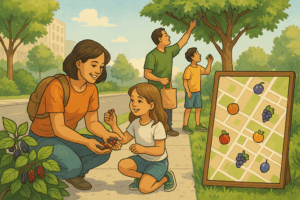
If grocery prices are giving you heart palpitations and the idea of maintaining a garden feels like a multi-year commitment you’re not spiritually ready for, here’s some good news: You already have a garden.
Urban Foraging: Your Free Neighborhood Bounty is Easier Than You Think
It’s on your sidewalk. It’s in the park. It’s behind the library parking lot.
Urban foraging may sound eccentric, but in 2026, it’s a practical, frugal, and surprisingly fun way to reclaim your food independence. Whether you’re a prepper building resilience or just a parent looking for a "treasure hunt" weekend activity, this is one of the easiest skills to start today.
Urban Foraging Basics Video
What is Urban Foraging?
Urban foraging is the practice of finding edible plants, berries, herbs, and fruit that grow naturally in cities and suburbs. Many cities use "edible landscaping" without even realizing it—think mulberries, blackberries, figs, rosemary, mint, and even citrus. Most of us walk past this bounty every single day without a second look.
The 2026 Digital Toolbox
You don't need a PhD in botany to start. You just need a few apps and a curious mind.
FallingFruit.org: This is the "Google Maps" of free food. Enter your ZIP code and zoom in to find community-mapped fruit trees and edible plants in your specific neighborhood.
The Gather App: This is a game-changer for 2026. Tailored specifically to your region, Gather shows you what's in peak season right now and includes side-by-side photo comparisons to help you avoid dangerous lookalikes.
Google Lens & iNaturalist: Use your camera to ID plants on the fly. Google Lens is great for a quick "what is this?" while iNaturalist connects you to a global community of experts who can verify your finds.
Safety First: The "False Parasol" Rule
Never eat anything unless you are 100% confident in your ID. For example, after heavy rains, inviting mushrooms often pop up in local lawns. Many are False Parasols—they look tasty, but they are highly toxic.
Follow these Urban Rules:
Wash everything. City dust is real.
Avoid heavy traffic zones. Pollutants settle on plants near busy roads.
Avoid "Perfect" lawns. If a lawn looks chemically treated or sprayed, skip it.
Stay public. Don't trespass. Stick to parks and public easements.
Easy Beginner "Weeds" to Forage
You likely have these "ingredients" hiding between your blades of grass right now:
Dandelions: Roast the roots for tea, eat the leaves in salad, or make jam from the flowers.
Clover: High in protein and perfect for brewing a mild, sweet tea.
Purslane: A succulent green with a citrusy kick. It’s a superfood that often grows through cracks in the sidewalk!
Garlic Mustard: An invasive species that’s actually delicious. Harvest it to help the environment and your pesto recipe.
Why This Matters (The Prepper Perspective)
Urban foraging is the ultimate low-stakes resilience training. If there is ever a grid-down situation or a major supply chain disruption, you don't want to be learning plant identification under stress. Practice now when the stakes are low and the snacks are free.
Final Thoughts
Urban foraging isn’t about replacing the grocery store; it’s about noticing the abundance that's already there. It’s part nature walk, part treasure hunt, and part budget-saver.
Have you found anything surprising in your neighborhood? Leave a comment below and share your finds!

No comments:
Post a Comment